
200 years of photography: celebrating the bicentenary of a major art form
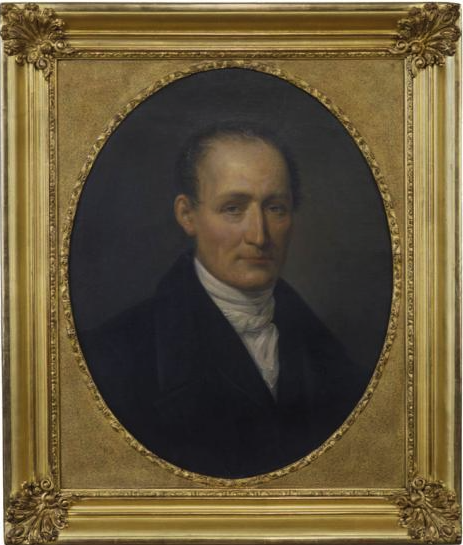
Nicéphore Niépce, inventor of photography
From September 2026 to September 2027, the French Ministry of Culture will celebrate the bicentenary of photography through numerous events organised throughout France.
This commemoration will pay tribute to Nicéphore Niépce, a French engineer and pioneer of imaging, whose research led to the birth of modern photography.
The discovery of photography: the genesis of a visual revolution.
The scientific and technical beginnings
Before Niépce’s work, the camera obscura was a widely used instrument in artistic and scientific circles. It allowed images of the outside world to be projected, but provided no means of permanent preservation. From the 1810s onwards, Niépce undertook systematic experiments with photosensitive substances. In particular, he explored silver salts before turning his attention to bitumen of Judea.
The first photograph in history
Nicéphore Niépce took this photograph using a camera obscura and a polished tin plate coated with bitumen of Judea. The dimensions vary depending on the source, but are around 16 x 20 centimetres. For a long time, it was believed that the exposure time was a whole day. However, reconstructions carried out in the 1990s showed that it was probably several days, due to the low sensitivity of the medium. Contrary to popular belief, and incorrectly reproduced in various magazines and publications on photography, Point de vue du Gras is not the first photograph ever taken.
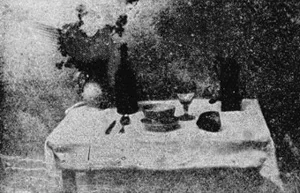
Niépce first produced a still life in 1822, Table Served, the very first successful attempt to fix a photographic image on a durable medium, which reproduces objects arranged on a table. Point of View from Le Gras is, however, the oldest photograph preserved to this day.
Heliography: a pioneering process
Judean bitumen has the property of hardening when exposed to light. Applied to a metal plate and exposed to light for several hours in a darkroom, Niépce managed to obtain a stable image after dissolving the unexposed areas.
This process, which he calls “heliography”, is a major innovation: the image is no longer interpreted by human hands, but produced mechanically by light itself. Despite its aesthetic and technical limitations, this image marks a turning point in the history of representation: reality is now recorded, rather than reconstructed.
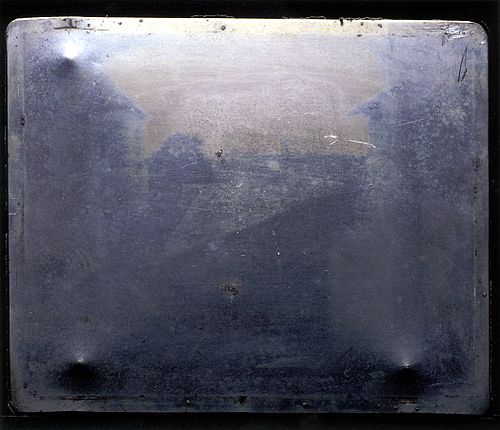
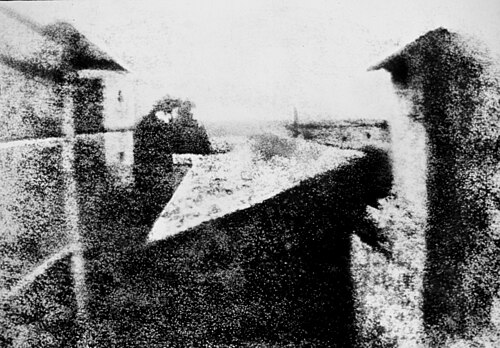
Taken from the window of Niépce’s family home in Saint-Loup-de-Varennes, the image known as Point de vue du Gras marks the culmination of heliography. The extremely long exposure time explains the unusual lighting of the scene.
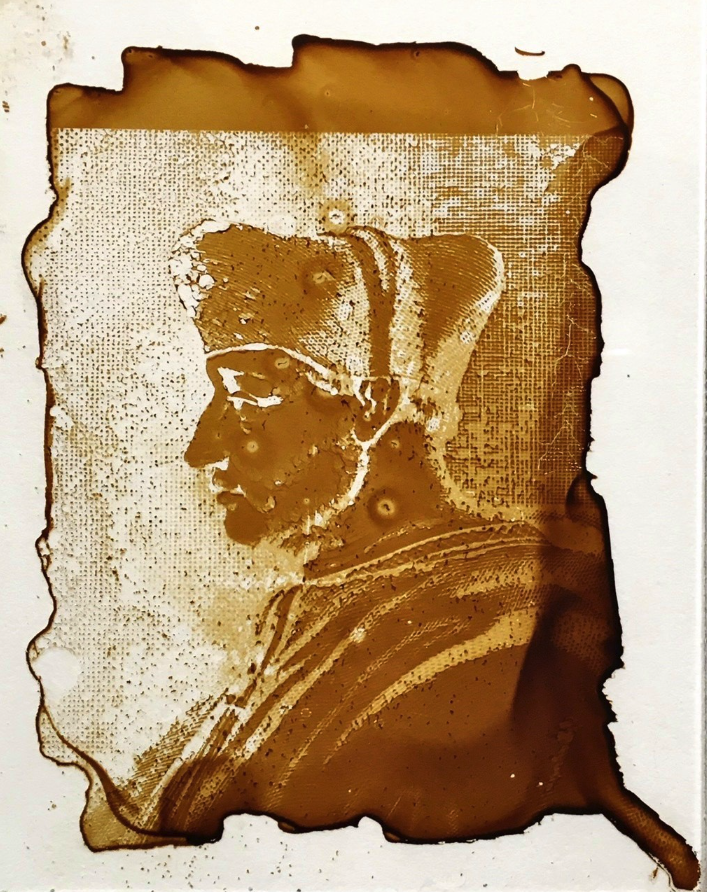
Coloured bitumen applied to a black background was no longer suitable, hence the initiative to propose a white photosensitive principle. In his notes on heliography, Daguerre makes this important point: “The lightest shade produced by this process is not white.” On 26 February 1830, at the beginning of the partnership between Daguerre and Nièpce, Daguerre wrote: “Judea bitumen seems to me, as it does to you, to have the necessary properties, with the exception of white. We must seek white and its opposite.”
The collaboration with Daguerre and Niépce’s legacy
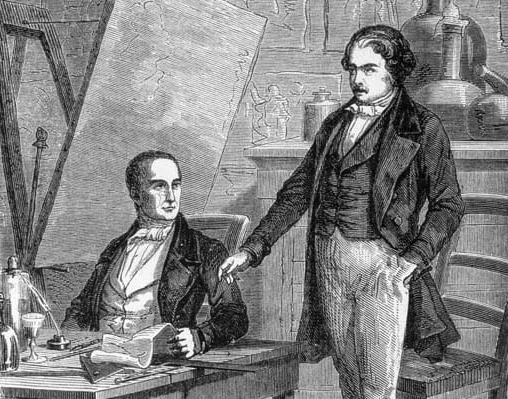
Aware of the limitations of his process, Niépce joined forces with Louis Daguerre in 1829. Their goal was to reduce exposure times. Niépce’s death in 1833 brought an end to this collaboration. Nevertheless, his research served as the basis for the daguerreotype, the first commercialised photographic process. For a long time, Niépce was overshadowed by Daguerre’s fame. Today, historians fully recognise his role as the inventor of photography.
The legacy of Nicéphore Niépce
Niépce’s contribution goes far beyond technical innovation. He ushered in a profound transformation in the ways in which reality is represented, understood and disseminated. Photography became a tool:
- Scientist,
- Documentary,
- Artistic,
- Cultural.
Today, it continues to shape our relationship with the world. Nicéphore Niépce is the founder of a major visual revolution. By enabling the permanent fixation of an image produced by light, he paved the way for modern photography.
The Bicentenary of Photography (2026–2027) thus provides a unique opportunity to showcase his work, his legacy and his importance in global cultural history.
Sources: Wikipedia – Nicéphore Niépce Museum – www.niepce-daguerre.com